
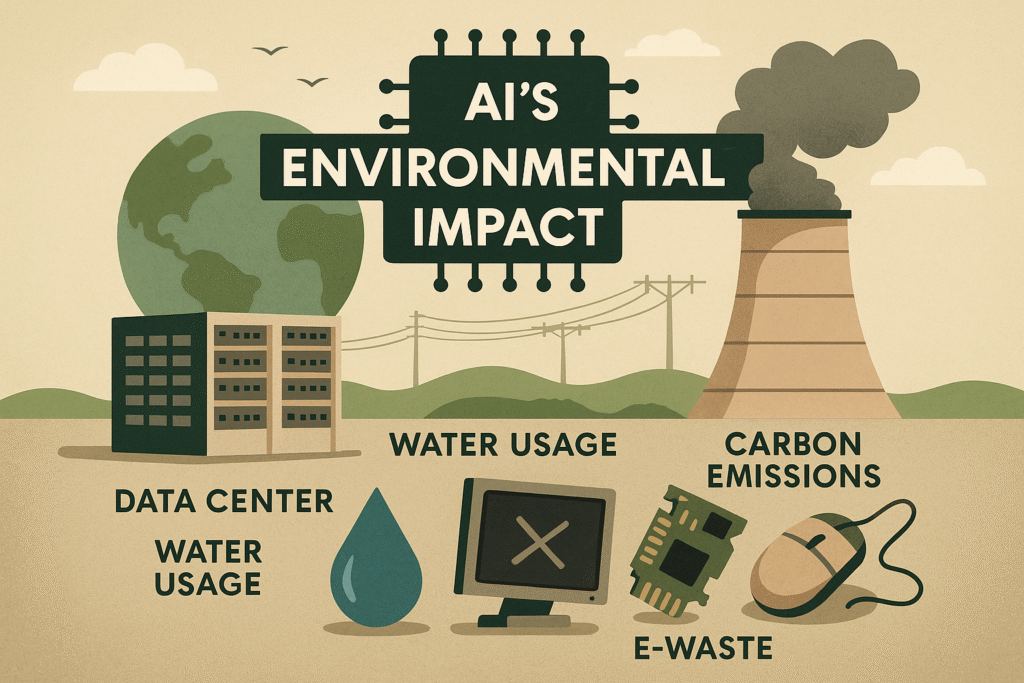
Artificial Intelligence is everywhere—writing our emails, curating our playlists, even predicting medical conditions. But behind the shiny surface of this tech revolution lies a reality that’s not talked about enough: AI’s hunger for energy is growing at an alarming rate, and it’s quickly becoming a serious environmental concern.
And no, it’s not just about sky-high electricity bills.
To keep these massive AI models running, we’re burning through resources—consuming huge amounts of water, generating piles of electronic waste, and contributing to greenhouse gas emissions—the very thing we’re all working to reduce in the fight against climate change.
As AI systems become more advanced and more deeply embedded in our daily lives, a critical question stares us in the face:
Can we fuel this AI revolution without harming the Earth?
India, being a tech powerhouse and home to a growing digital economy, must confront this question head-on. As we build the future with AI, we need to make sure we’re not breaking the planet in the process.
AI’s Energy Appetite: A Silent Storm Brewing in Our Power Grids
We all love asking ChatGPT for answers, using AI to draft emails, or seeing it power our apps—but here’s something most people don’t realise: AI’s energy consumption is exploding, and the numbers are startling.
🔢 The Numbers Don’t Lie
AI isn’t just evolving—it’s escalating. The computational power needed to train and run advanced AI models is shooting up so fast, some estimates suggest it’s doubling every few months. This isn’t a gradual trend—it’s a vertical spike, and even our best-prepared energy plans are struggling to keep up.
To put this in perspective:
- AI could soon consume as much electricity as entire countries like Japan or the Netherlands.
- By 2026, global data centres could demand 1,000 TWh—about what Japan uses in a year.
- By 2027, the energy thirst of AI-powered data centres may reach 68 GW, close to California’s total power capacity in 2022.
And back home? India, already dealing with energy access disparities and summer power cuts, must take this surge seriously.
⚡ AI’s Role in the Rising Global Demand
In 2024 alone, the world saw a record 4.3% surge in electricity demand, driven not just by EVs or industrial recovery, but also by AI’s exponential growth.
Back in 2022, data centres, AI, and crypto mining together used nearly 2% of global electricity—roughly 460 terawatt-hours (TWh). Fast forward to now:
- Data centres alone are already consuming 415 TWh, growing at 12% every year.
- AI’s direct usage is about 20 TWh today (0.02% of global power), but it’s rising sharply.
🔮 What’s Coming Next?
By end of 2025, AI data centres could need an extra 10 GW—that’s more than the total power generation of a U.S. state like Utah.
Looking further ahead:
- By 2030, global data centre energy use could double to 945 TWh (nearly 3% of global consumption).
- According to OPEC, it might even triple to 1,500 TWh.
- Goldman Sachs predicts a 165% jump in data centre demand over 2023 levels.
- AI-specific data centres could see their power demand quadruple in just a few years.
Some experts even warn that by the end of the decade, up to 21% of the world’s electricity could be tied to delivering AI services.
💻 Where Does the Power Go?
There are two energy-hungry stages in AI:
- Training the model – For instance, training GPT-3 consumed around 1,287 MWh, while GPT-4 reportedly required 50x more.
- Using the model (inference) – Surprisingly, over 80% of AI’s lifetime energy use goes into just running it for tasks like chatting, summarizing, or generating images.
To give you a fun comparison:
- A Google search uses ~0.3 Wh.
- A ChatGPT query? Around 2.9 Wh—almost 10x more.
What It Means for India
As India continues to invest in digital infrastructure and becomes a global hub for AI innovation, the energy impact of AI cannot be ignored.
With already stressed power grids, rising summer demands, and goals for a greener future, the country faces a tough balancing act—fuel innovation without frying the planet.
Can We Power AI—and Ourselves—Without Burning Out?
Here’s the real question that everyone’s quietly thinking about:
Can we really meet the exploding energy demands of AI… and still keep the lights on for the rest of us?
AI is hungry. Not just for data—but for electricity. And as it continues to grow, our already stretched energy systems are starting to feel the heat. We’re juggling everything from coal and gas to renewables and nuclear—but if we want to power this digital revolution sustainably, we’ll need to level up our energy game. And fast.
🌞 Renewables: A Big Piece of the Puzzle
Solar, wind, hydro, geothermal—these green sources are the future. Countries like the US are already on track to increase their renewable share from 23% in 2024 to 27% by 2026.
Big tech is jumping in too. Microsoft plans to buy 10.5 GW of renewable energy between 2026 and 2030 just for its data centres. That’s nearly the total power capacity of a state like Haryana!
And fun twist? AI might actually help fix the energy problem it’s causing. With smarter grid management, better forecasting, and more efficient storage solutions, AI could help cut power usage by up to 60% in some areas.
⚠️ But It’s Not All Sunshine and Windmills
Let’s be real: renewables aren’t perfect.
- The sun doesn’t shine at night.
- The wind doesn’t blow on demand.
- Batteries? They’re still expensive and space-hungry.
- And connecting new renewable projects to our existing power grids? That’s a bureaucratic nightmare.
For data centres that need 24/7 power, 365 days a year, this “on-off” nature of renewables just doesn’t cut it.
☢️ Nuclear: The Silent Contender
This is where nuclear energy starts looking interesting. It’s low-carbon, high-output, and, crucially, always on—exactly what power-hungry data centres need.
And no, this isn’t sci-fi.
Companies like Amazon, Google, and Microsoft are exploring nuclear energy seriously, especially Small Modular Reactors (SMRs)—which are safer, more compact, and quicker to build than traditional reactors.
AWS (Amazon Web Services) exec Matt Garman recently told the BBC that nuclear is “a great solution” for data centres because it provides zero-carbon, 24/7 power—the holy grail for AI infrastructure.
“We invest years in advance,” Garman said. “The world will have to build new technologies, and nuclear is a big part of that.”
🧱 The Catch?
But here’s the hiccup: nuclear takes time.
- Building a new reactor takes years, sometimes decades.
- It costs a fortune.
- And it comes with layers of safety regulations (for good reason).
Public trust is another hurdle. Even with today’s safer designs, nuclear energy still makes many people uneasy—especially in countries like India, where memories of disasters like Chernobyl or Fukushima still linger.
On top of that, AI is moving at lightning speed, while nuclear infrastructure moves at, well… government speed. This mismatch could mean relying more on fossil fuels in the short term, which isn’t ideal for our climate goals.
Some are even worried about placing data centres near nuclear plants, fearing it might hike up electricity prices for everyday consumers—or create reliability issues for local communities.
So, where does that leave us?
We’re at a crossroads. To power AI and everything else, we’ll need a balanced, bold energy strategy—one that mixes innovation, policy, public trust, and long-term vision.
India, with its booming tech scene and growing energy needs, can’t afford to stay on the sidelines. Whether it’s green AI, better storage tech, or rethinking how we build data centres, we need solutions that work for both progress and the planet.
🌍 AI’s Environmental Shadow: It’s Not Just About Electricity
We often talk about AI’s power needs in terms of kilowatts and gigawatts. But the real environmental cost of AI runs much deeper—touching our water resources, e-waste, natural materials, and of course, the climate crisis.
Let’s break it down.
💧 The Water Thirst No One Talks About
Ever wondered how data centres stay cool while crunching all that data?
The answer: Water. Lots of it.
Your average data centre gulps down around 1.7 litres of water per kilowatt-hour of electricity it uses. Back in 2022, Google’s data centres consumed over 5 billion gallons of fresh water—a 20% spike from the year before. To put that in perspective, global AI infrastructure could soon use six times more water than an entire country like Denmark.
This is no small issue, especially for a water-stressed country like India, where every drop counts.
🧯 The Growing E-Waste Mountain
Then comes the problem of e-waste. AI hardware—think GPUs and TPUs—evolves so fast that old components are dumped at a staggering pace. By 2030, AI-driven data centres alone could be generating up to 5 million tons of e-waste every year.
And manufacturing these chips? That’s no picnic either.
Creating just one high-end AI chip takes:
- 1,400 litres of water
- 3,000 kWh of electricity
- And critical minerals like lithium and cobalt, often extracted through environmentally harmful mining.
All of this is pushing for more semiconductor factories—and many of these are still powered by fossil fuels.
🌫️ Carbon Emissions: The Elephant in the Server Room
When AI runs on electricity from coal or gas, it worsens the very problem we hope AI might help solve—climate change.
Training a large AI model like GPT-4 is estimated to emit as much CO₂ as hundreds of homes do in a year.
Big Tech’s own reports show the damage:
- Microsoft’s emissions jumped by 40% from 2020 to 2023—largely from building AI-ready data centres.
- Google’s emissions rose nearly 50% in just five years.
🔧 Can We Innovate Our Way Out of This?
Thankfully, not all hope is lost. Innovation might just be our best ally.
Smarter AI Algorithms
- Model pruning – trim the fat off large models
- Quantisation – use smaller numbers to save energy
- Knowledge distillation – teach a small model to mimic a larger one
These all help build lighter, less energy-hungry AI systems.
Greener Data Centres
- Power capping – limit how much energy hardware can draw
- Dynamic resource allocation – use computing only when needed
- AI-aware scheduling – delay non-urgent AI tasks to cleaner energy hours
Even cooling systems can be optimized with AI, reducing the need for excess water.
On-Device AI
AI that runs directly on your phone or laptop—without needing the cloud—can dramatically reduce energy use. With India’s growing smartphone market, on-device AI could be a game-changer for balancing tech and sustainability.
🏛️ The Role of Policy and Accountability
Tech solutions alone won’t cut it.
Governments worldwide, including in India, must step up:
- Standardize AI energy usage reporting
- Push for longer-lasting, recyclable hardware
- Incentivize green innovation with carbon credits or tax benefits
We also need to keep energy equity in mind. If AI data centres soak up too much power, what happens to rural electrification, small industries, or healthcare services that need reliable electricity?
🇮🇳 India’s Moment of Reflection
As the UAE and the US plan the world’s largest AI campus, it reminds us that the global AI race is heating up—but it also throws a spotlight on why sustainability must be part of the blueprint.
India, with its mix of tech talent, policy reform, and renewable energy potential, is in a unique position. We can lead the way in building a sustainable AI future—but only if we act now.
🔚 The Road Ahead: Sustainable AI or Bust
The future of AI is dazzling—but it’s also demanding. Power grids, water supplies, and the environment are all under pressure. If we want AI to empower humanity, not exhaust it, then we need a new mantra:
Not just faster AI. Smarter, greener AI.
That means:
✅ Energy-efficient models
✅ Cleaner power sources
✅ Better hardware management
✅ And strong policies to back it all
The race to lead in AI must also be a race to lead in sustainable AI—for the planet, for the people, and for generations to come.